

The Order Retirees Tap Their Accounts Can Change a Lifetime Tax Bill, Says Bean Harbor Advisors
Withdrawal sequencing, the choice of which accounts fund retirement spending and in what order, is among the most overlooked ways to optimize retirement income while reducing taxes, according to fiduciary advisor Jeff Blocker.
BOSTON, MA, Sept. 01, 2026 (GLOBE NEWSWIRE) -- Two retired households can hold identical savings, spend identical amounts, and earn identical returns, yet pay meaningfully different taxes over the course of retirement.
According to Bean Harbor Advisors Founder and fiduciary financial advisor Jeff Blocker, the difference frequently comes down to a decision many retirees never realize they are making: the order in which their accounts fund their life.
Withdrawal sequencing is the deliberate ordering of retirement income across the three tax characters of savings: taxable accounts such as brokerage and bank accounts, tax-deferred accounts such as traditional IRAs and 401(k)s, and tax-free accounts such as Roth IRAs. Each character is taxed differently when money comes out, which means the same dollar of spending can cost different amounts depending on where it is drawn from and when.
One point of terminology deserves care. Withdrawal sequencing is a tax concept, distinct from sequence of returns risk, the market-timing risk this firm examined in an earlier analysis. That risk concerns the order in which markets deliver returns. This discussion concerns the order in which a household spends its account types. The two interact, but they are different problems with different tools.
"People assume the big tax decisions ended when they stopped working," said Jeff Blocker, Founder and Financial Advisor at Bean Harbor Advisors. "It is closer to the opposite. In retirement you effectively choose your own taxable income every year, by choosing which accounts fund your spending. That choice deserves a strategy."
The Conventional Order, and Its Logic
The traditional rule of thumb runs taxable first, tax-deferred second, tax-free last. Spend the brokerage account while deferred accounts keep compounding, then draw the IRA, and preserve the Roth longest because its growth is never taxed again.
The logic is sound as far as it goes, and for some households it remains a reasonable baseline. Taxable accounts often carry the lightest tax cost to spend, particularly where long-term capital gains rates apply or where holdings carry a high cost basis. Letting tax-advantaged accounts compound longer is usually valuable.
The trouble, Blocker notes, is that the rule was built for a simpler landscape. Followed rigidly, it can produce a decade of artificially low taxable income early in retirement, followed by a collision later: required minimum distributions arriving on a fully intact deferred balance, on top of Social Security, pushing a household into brackets and premium surcharges it never needed to visit.
"The conventional order spends the cheapest dollars first and saves the tax problem for later," Blocker explained. "The refinement is realizing that later has a shape. You can see the required distributions coming years in advance, and you can flatten the mountain before it arrives."
Filling Brackets Instead of Following Rules
The refinement most planners apply is bracket management: rather than minimizing taxes every single year, the household aims for a steadier taxable income across all years, using the low-income seasons of early retirement deliberately.
In practice, that can mean drawing some tax-deferred money, or converting portions of it, during the window between retirement and required distributions, even when taxable funds could have covered spending. Each year, income is sized to fill the household’s current bracket without spilling into the next one, and to stay mindful of the thresholds that matter: the levels at which Social Security benefits become taxable, Medicare premium surcharges begin, and the net investment income tax applies.
Blended approaches are common. A year’s spending might combine taxable dollars, a measured deferred withdrawal sized to bracket room, and, in high-need or high-income years, tax-free Roth dollars to keep the total below a threshold. The Roth account earns a second job in this design: not merely the last account spent, but a pressure valve that lets a household add income without adding taxable income.
Where the Pieces Interact
Sequencing decisions ripple across the rest of the retirement plan:
- Social Security: the portion of benefits subject to tax depends on other income, so withdrawal order can change how much of a benefit a household keeps
- Medicare: income two years ago sets today’s premium surcharges, giving every large withdrawal a delayed premium consequence
- Required minimum distributions: drawing down or converting deferred balances earlier shrinks the forced income that begins at age 73 under current law
- Charitable giving: qualified charitable distributions can satisfy required distributions without adding taxable income for givers past age 70 and a half
- Heirs: since the SECURE Act, most non-spouse beneficiaries empty inherited retirement accounts within ten years, so which accounts remain at the end shapes the tax bill a family’s children inherit
Asset location, holding tax-inefficient investments inside tax-advantaged accounts and tax-efficient ones in taxable accounts, works quietly alongside the ordering decision, reducing the tax drag of the portfolio itself while the sequencing plan manages the tax cost of spending it.
"There is no universal right order," Blocker said. "There is a right order for this household, this year, at these thresholds. That is why we revisit the plan every year instead of laminating a rule and following it for thirty years."
A Simplified Illustration
Consider two hypothetical couples, each retiring at 65 with the same balances spread across a brokerage account, traditional IRAs, and modest Roth accounts, each spending the same amount, and each delaying Social Security to 70. The illustration is simplified and not a projection, but the pattern it shows is structural.
The first couple follows the rigid conventional order, spending only brokerage dollars for eight years. Their tax returns during that stretch look wonderful: little taxable income, minimal tax. Then the sequence turns. The brokerage account is exhausted, both Social Security checks begin, and required distributions arrive on IRAs that compounded untouched for years. Their taxable income jumps sharply, more of their benefits become taxable, and their Medicare premiums step up with it. The low-tax years were real, but they were also wasted: brackets sat empty that could have absorbed cheap withdrawals.
The second couple blends from the start: brokerage dollars for most spending, plus deliberate IRA withdrawals or conversions sized each year to fill the lower brackets, stopping short of the premium thresholds. Their early returns show modestly more tax. But by the time required distributions begin, their deferred balances are smaller, the forced income is lower, and their taxable income runs comparatively level for the rest of retirement. Same money, same spending, different order, and a meaningfully different lifetime tax path.
An Annual Decision, Not a Retirement-Day Decision
Bean Harbor Advisors builds withdrawal sequencing into each household’s annual review. Late in the year, once income and market results are largely known, the firm models where the household sits in its bracket, which thresholds are near, and which combination of accounts should fund the coming year’s spending, coordinating the analysis with the household’s tax professional.
The inputs change constantly: markets move balances, tax provisions evolve, health and family circumstances shift spending. The discipline is what stays fixed. Households that treat withdrawal order as a living annual decision, Blocker notes, tend to arrive at their required-distribution years with smaller forced incomes, steadier premiums, and more flexibility than households that simply spent accounts in the order they happened to think of them.
"Optimizing retirement income while reducing taxes is not a product you buy," Blocker said. "It is a sequence of small decisions, made on purpose, every year, in the right order. Families are often surprised that the strategy costs nothing except attention."
Because every household’s tax circumstances differ, the firm emphasizes that sequencing concepts are educational rather than individualized advice, and encourages families to evaluate their own withdrawal order with a fiduciary advisor and a qualified tax professional together.
The starting point costs nothing: an inventory. Households can list every account by tax character, note its balance and its rough share of the total, and ask one question of the coming year: which combination of these sources funds our spending at the lowest lasting cost? Families who can answer that question, Blocker observes, are already doing withdrawal sequencing. Families who have never asked it are usually leaving money on the table every single year.
As larger retirement account balances meet longer retirements, Bean Harbor Advisors expects withdrawal sequencing to move from a specialist refinement to a standard expectation of competent retirement income planning, alongside the claiming, conversion, and Medicare coordination the firm has examined in its recent analyses.
Frequently Asked Questions
Which accounts should I withdraw from first in retirement?
The traditional order is taxable first, tax-deferred second, Roth last, but the better answer is household-specific: many retirees benefit from blending sources each year to fill their current tax bracket and stay under Medicare and Social Security thresholds.
What is tax-efficient withdrawal sequencing?
It is the deliberate ordering of retirement income across taxable, tax-deferred, and tax-free accounts, sized each year to manage brackets, benefit taxation, premium surcharges, and future required distributions, with the goal of reducing lifetime taxes.
How do withdrawals affect Social Security taxes and Medicare premiums?
Other income determines how much of a Social Security benefit is taxable, and income from two years earlier sets Medicare premium surcharges, so the size and source of each withdrawal can change both.
What is asset location?
Asset location places tax-inefficient investments inside tax-advantaged accounts and tax-efficient investments in taxable accounts, reducing the portfolio’s ongoing tax drag while withdrawal sequencing manages the tax cost of spending.
Key Facts
|
Related Resources
- Retirement income planning with Bean Harbor Advisors
- Meet the Bean Harbor Advisors team
- IRS: retirement plans and IRA resources
- Investor.gov (SEC): investment products and basics
- Social Security Administration: retirement benefits
About Bean Harbor Advisors
Bean Harbor Advisors is an independent fiduciary financial advisory firm dedicated to helping individuals and families prepare for and navigate retirement with confidence. The firm specializes in retirement income planning, Social Security and Medicare guidance, tax-aware retirement strategies, estate planning coordination, and holistic financial planning designed to help clients make informed long-term financial decisions.
For more information please visit: https://beanharbor.com
Attachment

NEWMEDIA.COM
One World Trade Center
285 Fulton Street, Suite 8500
New York, NY 10007
212-220-6200
hello@newmedia.com

Retirement Withdrawal Order, Explained
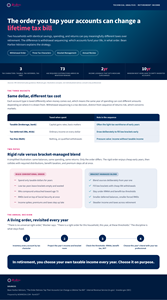
How tax-efficient withdrawal sequencing across taxable, tax-deferred, and Roth accounts reduces lifetime taxes. Source: Jeff Harbor of Bean Harbor Advisors.
Legal Disclaimer:
EIN Presswire provides this news content "as is" without warranty of any kind. We do not accept any responsibility or liability for the accuracy, content, images, videos, licenses, completeness, legality, or reliability of the information contained in this article. If you have any complaints or copyright issues related to this article, kindly contact the author above.
